9 Strategies to Help You Retain 80% of What You Read.

9 Strategies to Help You Retain 80% of What You Read.
9 Strategies to Help You Retain 80% of What You Read.
Honestly, each strategy by itself will help you remember at least 60% of everything you read.

Have you ever felt frustrated after reading an incredible book, like Outlive by Peter Attia or Atomic Habits by James Clear, only to realize later that you can barely remember any of it? It’s a common problem. You invest your time, energy, and focus into reading something impactful, but when it’s time to recall key concepts, your mind comes up blank.
I used to feel the same way. I’d read a book, claim it was life-changing, and then promptly forget most of its content. It was frustrating, and I felt like I had a terrible memory. But over time, I learned that it wasn’t about my memory being flawed — it was about my approach to reading. Once I discovered how memory and retention truly work, everything changed.
Now, I can read a book, remember 80% of its content, explain its concepts in conversations, and even apply the lessons to my life. And you can do it too. Here are nine actionable strategies to help you remember more of what you read:
1. Eliminate Distractions and Stay Present
According to Nelson Dellis, a memory champion who memorized 339 digits in five minutes, paying attention is the foundation of memory. He says.
“If you don’t pay attention, you don’t remember,”
When you’re reading, focus is everything. Here’s how to set yourself up for success:
- Remove distractions: Put your phone on silent, close unnecessary tabs on your laptop, and listen to lyric-free music to enhance concentration.
- Engage your curiosity: Continuously ask yourself, “How can I use this in my life?” This keeps you engaged and helps identify important insights.
2. Visualize the Content Like a Movie

Our brains are hardwired to remember visual information better than abstract ideas. While reading, imagine the concepts unfolding as scenes in a movie. For example, if you’re reading a self-help book, envision yourself applying the advice in real-life scenarios.
James Clear, author of Atomic Habits, emphasizes this point:
“You do not rise to the level of your goals. You fall to the level of your systems.”
Visualize building these systems as vividly as you can.
3. Write Down Key Ideas by Hand
Studies show that handwriting helps reinforce memory better than typing. Beethoven understood this well. He’d jot down ideas in sketchbooks and later said, “If I don’t write it down immediately, I forget it right away. If I put it into a sketchbook, I never forget it and I never have to look it up again.”
When you write, you’re forced to distill the information to its essence, which enhances understanding and retention. Keep a notebook handy to jot down key insights as you read.
4. Interact Actively with the Book
Reading should be an active, not passive, process. Engage with the material by:
- Highlighting or underlining impactful sentences.
- Adding symbols (e.g., stars for crucial points, question marks for areas of skepticism).
- Writing your thoughts or questions in the margins.
- Using sticky notes to mark important pages for quick reference later.
Remember, the value of a book isn’t in its physical form but in the ideas it imparts.

5. Apply What You Learn Immediately
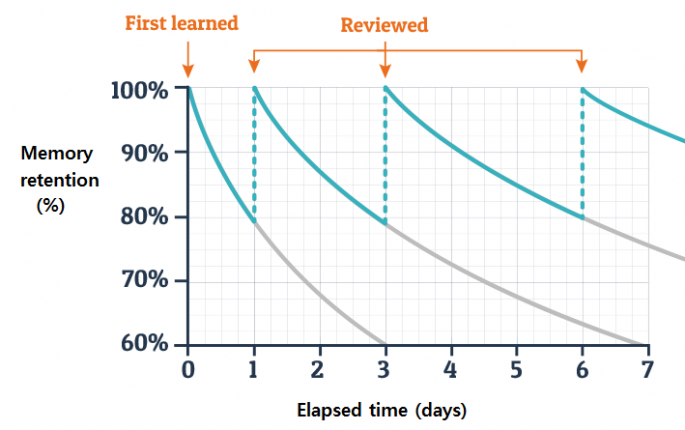
Memory expert Ebbinghaus’s “Forgetting Curve” shows that we forget most of what we read within 24 hours unless we actively apply it. If you read a book on habits, implement at least one habit-building tip that day. As Confucius wisely said, “I hear and I forget. I see and I remember. I do and I understand.”
6. Teach Someone Else
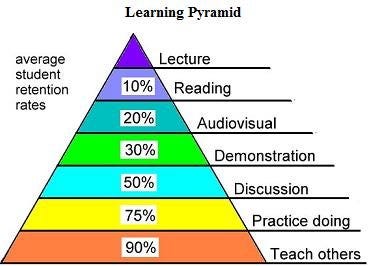
Teaching is one of the most powerful ways to reinforce learning. When you teach, you’re forced to simplify and explain the material in your own words, which helps cement the concepts in your mind.
The Learning Pyramid suggests that teaching others leads to a 90% retention rate. So, share interesting ideas from your reading with friends, family, or colleagues.
7. Review Regularly Using Spaced Repetition
Spaced repetition is a scientifically-backed technique for retaining information over the long term. Here’s the Rule of 5:
- Review the key points 5 times on the first day.
- Revisit once a day for the next 5 days.
- Then review weekly for the next 5 weeks.
By regularly revisiting the material, you solidify it in your long-term memory.
8. Connect New Ideas to Existing Knowledge
Memory works best when it’s associative. Try to relate new concepts to things you already know. For example, if you’re reading about habits, connect it to your own routines or past experiences.
As Albert Einstein said, “If you can’t explain it simply, you don’t understand it well enough.” By linking new information to your existing mental framework, you’ll make it easier to recall later.

9. Set Reading Goals and Reflect
Before starting a book, define why you’re reading it and what you hope to gain. After finishing it, spend 10 minutes reflecting on the key takeaways. Summarize what you’ve learned and how you plan to use it.
Peter Drucker once said, “Knowledge has to be improved, challenged, and increased constantly, or it vanishes.” Reflection is how you ensure that your reading translates into actionable insights.
Final Thoughts
Reading isn’t just about consuming words — it’s about transforming your mind. By using these nine strategies, you can not only remember 80% of what you read but also turn that knowledge into a powerful tool for personal growth.
Now, the next time you pick up a book, approach it with intention. Read actively, engage with the material, and most importantly, use what you learn. Your future self will thank you!
