You Don’t Need to Be Fixed to Be Worthy

You Don’t Need to Be Fixed to Be Worthy
You Don’t Need to Be Fixed to Be Worthy
My book is not a manual — it’s a reminder that you’re already enough
I’ve noticed something strange about the way we talk about ourselves. Almost every conversation seems to circle back to fixing.
Fix your habits.
Fix your mindset.
Fix your routines.
Fix the part of you that isn’t measuring up to someone else’s definition of “enough.”
And it’s exhausting. Because the more you try to fix yourself, the more you start to believe that you’re broken.
That there’s something fundamentally wrong with you until you’ve optimized every corner of your life.
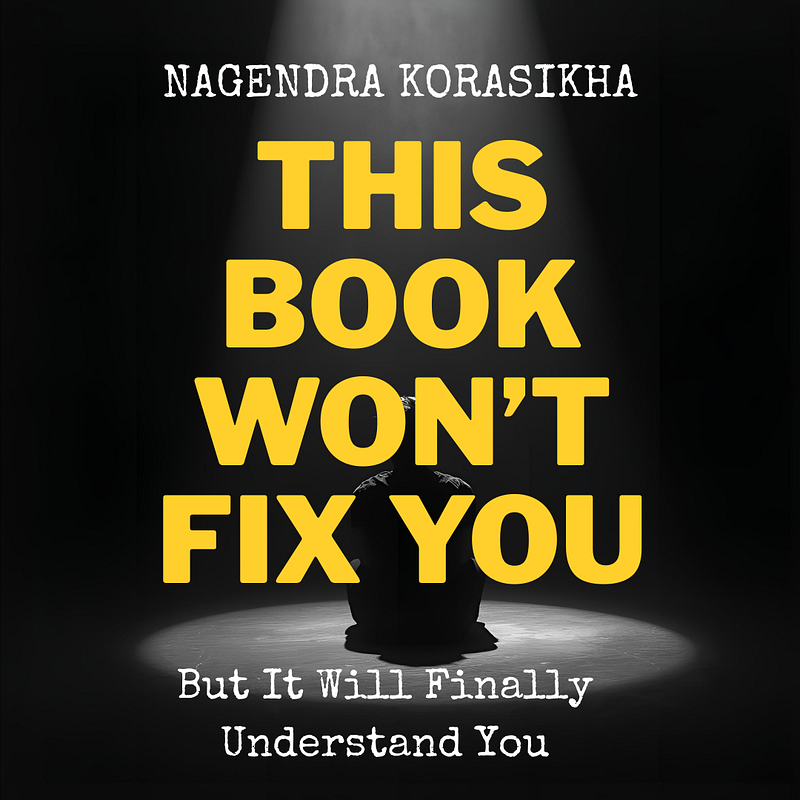
That was the thought sitting in my chest when I began writing This Book Won’t Fix You.
The title itself came first, almost like a protest. I didn’t want to add one more “how-to” to the mountain of self-help advice already out there. I didn’t want to tell people to wake up earlier or smile harder or journal until their pain disappeared.
I wanted to write the opposite.
I wanted to say: you’re not broken. You don’t need fixing.
Every page of the book came out of the quiet hours — moments when I felt the weight of my own confusion and tiredness.
I wasn’t writing to sound wise.
I wasn’t writing to impress anyone.
I was just writing the words I wish someone had said to me: you’re allowed to exist exactly as you are.
The truth is, we’re not projects.
We’re people. And people don’t need constant updates like an app on a phone.
We don’t need to wait until we’re “fixed” to deserve love or belonging. We don’t need to perform happiness to be considered valuable.
Sometimes, we just need someone to witness us.
To sit with us in the messy middle — the in-between space where we’re neither falling apart nor fully healed.
That’s what this book tries to do. It doesn’t give solutions. It offers presence.
One of the hardest lessons I’ve learned is that being human isn’t about being consistent.
It’s not about always being strong, productive, or joyful. Being human is about the ups and downs, the questions that don’t have answers, the pauses that feel endless.
And when you stop trying to fix every part of yourself, you create space to simply feel those things.
To let them move through you instead of fighting them like enemies.
Some chapters in the book are only a page long. Others spill into three or four.
But none of them are long lectures. They’re small reminders. Little truths you can carry in your pocket.
Like: “You’re not lazy — you’re just running on empty.” Or, “Healing isn’t a race — you can’t fall behind in becoming yourself.” Simple words, but sometimes those are the only ones we need.
I’ve had readers tell me they don’t read it straight through.
They keep it on their desk or their nightstand, and they open it when the silence feels too heavy.
Sometimes they read a single paragraph and close the book. And that’s enough.
That’s exactly what I hoped it would be — not a guide, not a manual, just a companion.
And honestly, I think that’s why this book means so much to me personally. It’s proof that words don’t have to be polished or perfect to matter. They just have to be real.
If you’ve ever felt like you’re behind, like you’re too much, or like you’ll only be worthy once you’ve “fixed” yourself, I want you to hear this clearly: you’re already enough.
You don’t need to upgrade yourself to earn love. You don’t need to wait until your wounds have healed to be valuable. You are worthy here, now, exactly as you are.
That’s the heart of This Book Won’t Fix You.
It’s not a cure, not a quick fix, not a motivational speech.
It’s a reminder. A mirror held gently in front of you. A friend who doesn’t try to change you — just sees you.
So if you’re tired of books that make you feel like a problem to solve, maybe this one will feel different.
Not because it will fix you, but because it will remind you: you were never broken in the first place.
