Magnesium Is the Most Ignored Supplement in the World.

Magnesium Is the Most Ignored Supplement in the World.
Magnesium Is the Most Ignored Supplement in the World.
Most People Are Already Deficient and Do Not Know It.
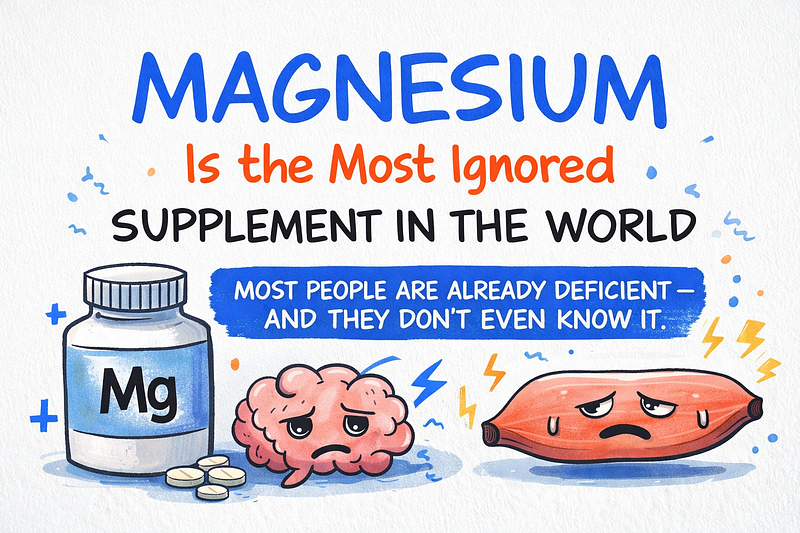
There is a symptom most people have right now.
They are tired even after sleeping. Their muscles are slightly tense for no reason. They feel anxious without anything specific to be anxious about. They cannot sleep deeply even when they are exhausted. They get headaches that come and go without explanation.
Most people call this stress.
Most doctors call this modern life.
Almost nobody calls it what it actually is.
A magnesium deficiency.
The Mineral Nobody Talks About
Walk into any supplement store and look at what is being marketed loudly.
Protein powders with complicated names. Pre-workouts with ingredients you cannot pronounce. Collagen drinks in expensive packaging. Vitamin C in ten different forms.
All of it expensive. All of it heavily advertised. All of it positioned as the thing your body is missing.
And quietly sitting on the bottom shelf , often in a plain white bottle with no celebrity behind. It is magnesium.
The supplement responsible for over 300 enzymatic reactions inside your body.
The one most people are not getting enough of.
The one almost nobody is talking about.
What Magnesium Actually Does
Most people think of magnesium as something for muscle cramps. Something athletes take.
That is not what magnesium is.
Every time your body produces energy →magnesium is part of that process.
Every time a nerve sends a signal →magnesium is involved.
Every time a muscle relaxes after contracting→magnesium makes that happen.
It is the fourth most abundant cation in the human body. And yet it is the one most consistently ignored — by supplement companies, by doctors, and by the people who need it most.
Your body runs on magnesium the way a car runs on oil. Not the fuel. The thing that keeps the engine from destroying itself.
When you do not have enough, everything runs slightly worse. Not dramatically. Just slightly. In ways that feel like tiredness, tension, anxiety, and poor sleep.
In ways that feel exactly like modern life.
How Deficient Are People Actually
This is the number that makes people stop.
Some estimates go higher. One review found that 60% of adults do not achieve the average dietary intake and 45% of Americans are magnesium deficient.
Not a small group. Not a rare condition. Potentially half the population running on low magnesium and attributing the symptoms to stress, age, or just how they are.
The reason is not complicated.
On top of that →processed food contains almost none. Chronic stress depletes it. Certain medications including diuretics and PPIs deplete it further.
Modern life is systematically removing magnesium from the body while modern farming is simultaneously removing it from food.
The Symptoms That Look Like Everything Else
This is why magnesium deficiency is so difficult to identify.
But the everyday symptoms are subtler.
Difficulty sleeping deeply. Not insomnia exactly. Just sleep that does not fully restore.
Muscle tension. Tightness in the shoulders, neck, and jaw that is always slightly there.
Fatigue that does not resolve with rest.
Regular headaches and migraines.
Every single one of these symptoms has a hundred possible explanations. Most people cycle through them blaming work, sleep, age, stress, without ever considering that the cause might be one mineral.
The most common reason magnesium deficiency goes unnoticed is that it is too easy to explain away.
Why Your Blood Test Will Not Tell You
Here is something that makes this even more complicated.
If you ask a doctor to check your magnesium levels they will run a standard blood test. The test comes back normal. You are reassured and move on.
When magnesium is low the body pulls it from cells and bones to maintain blood levels. The blood looks fine. The cells are running low.
You can be genuinely deficient in magnesium and have a completely normal blood test. This is why so many deficiencies go undetected for years.
What Magnesium Does for Sleep
This is the connection most people have never heard explained clearly.
GABA is essentially the brain’s off switch. Magnesium helps activate it.
Low magnesium means the off switch works less effectively. The mind stays slightly activated when it should be winding down.
The experience of lying awake with a mind that will not fully switch off is sometimes not an anxiety problem. It is a magnesium problem.
What Magnesium Does for Anxiety
Magnesium ions function in the body as NMDA receptor antagonists — opposing the excitatory action of calcium in the central nervous system. In simpler terms — magnesium helps put the brakes on an overactive stress response.
This produces a feeling that is difficult to name. Not fear. Not panic. Just a background hum of unease that is always present.
Millions of people live with this feeling and call it their personality.
For a significant number of them it is not their personality. It is their magnesium level.
The Foods That Contain It
Before the supplement conversation → the food.
Dark leafy greens. Spinach, kale, Swiss chard. These are among the richest dietary sources.
Nuts and seeds. Pumpkin seeds in particular contain exceptional amounts.
Legumes. Black beans, lentils, chickpeas.
Dark chocolate. A small amount of high-quality dark chocolate contains meaningful magnesium.
Whole grains. Brown rice, oats, quinoa.
The pattern is consistent. Whole unprocessed foods contain magnesium. Processed foods do not — refined foods are significantly depleted of magnesium during processing.
If your diet is built largely on processed food you are almost certainly not getting enough magnesium from food alone.
The Supplement Problem Nobody Mentions
Here is where most people make the first mistake.
They decide to supplement. They buy the cheapest bottle at the pharmacy. They take it for two weeks. They notice nothing. They conclude magnesium does not work for them.
What they do not know is that magnesium oxide — the form in most cheap supplements — has a bioavailability of approximately 4%. You take 400mg. Your body uses approximately 16mg. The rest passes through.
The form matters enormously. The dose matters. The timing matters. What you take it with matters.
Magnesium-L-threonate is the only form shown to effectively cross the blood-brain barrier — making it specifically relevant for cognitive function and brain health. Glycinate is the best absorbed form for sleep and anxiety. Citrate works well for general deficiency.
Most people taking magnesium right now are taking the wrong form at the wrong time.
Which means most people have tried magnesium and think it did not work. When in reality they just did not have the right information.
So If You Are Dealing With This . Here Is the Honest Summary
If you are dealing with poor sleep, constant muscle tension, unexplained anxiety, or fatigue that does not resolve with rest → magnesium might genuinely be the missing piece.
The research is clear. The deficiency is widespread. The solution is real.
But knowing magnesium matters is only half the answer.
The other half → the half most articles never give you, is knowing exactly what to do about it.
Which form actually works for your specific problem. How much elemental magnesium you actually need. When to take it for sleep versus anxiety versus energy. What blocks absorption completely. What to expect in the first seven days and what takes longer.
Get these wrong and nothing changes.
Get them right and most people notice a difference within two weeks.
The Magnesium Protocol: 7-Day Fix
I put everything into a short practical guide.
Not a long complicated book. Not hours of research. Just the exact protocol, every decision already made for you.
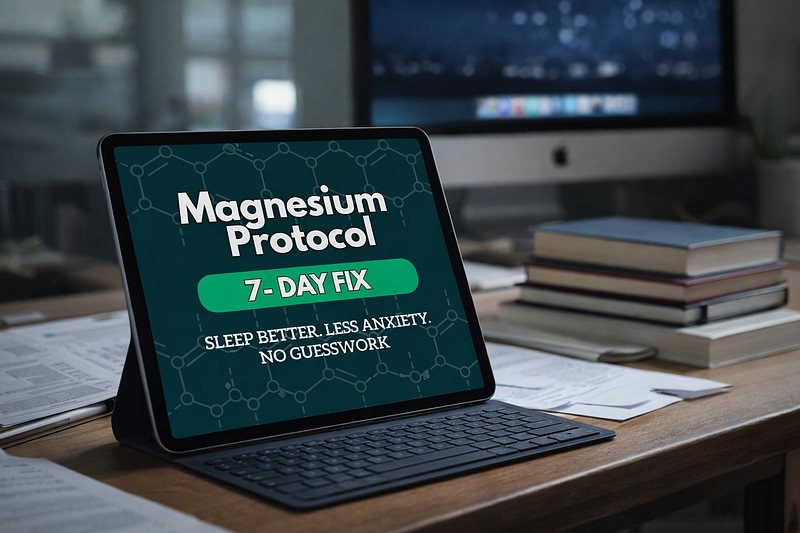
Inside:
→ The only three forms worth buying — and which one matches your specific symptoms
→ The exact elemental dose — not the capsule weight, the actual number that reaches your cells
→ The timing protocol — when to take it for sleep, anxiety, energy, and brain function
→ The 7-day plan — day by day, what to take, what to expect, and what to watch for
→ The five mistakes that make most people’s supplementation completely ineffective
→ The three foods that deliver more absorbable magnesium than most supplements
Most people who follow it notice:
- Better sleep within a few nights
- Reduced background anxiety that has been present for months
- Less muscle tension in the shoulders, neck, and jaw during the day
I kept it short on purpose so you can finish it in under 30 minutes and actually use it.
You can read the book here !!!
This article is for informational purposes only. I am not a doctor. Please consult a healthcare professional before starting any supplement, especially if you have existing medical conditions or take medications.
References
- Global dietary magnesium deficiency — PubMed 2025
- Magnesium: health effects and deficiency burden — PubMed 2025
- Magnesium disorders and management — PMC
- Subclinical magnesium deficiency — PMC
- Challenges in diagnosing magnesium status — PubMed
- Suboptimal magnesium in the United States — PubMed
- Magnesium depletion score — PMC 2025
- Magnesium deficiency pathogenesis — PubMed
- Magnesium and depression and anxiety — PMC 2025
- Magnesium and sleep quality — CARDIA study PMC
- Magnesium and sleep disorders — PMC 2025
- Magnesium-L-threonate and sleep — PMC
- Magnesium for insomnia — double-blind RCT PMC
- Magnesium and anxiety — systematic review PubMed
- Magnesium as NMDA antagonist — PMC
